
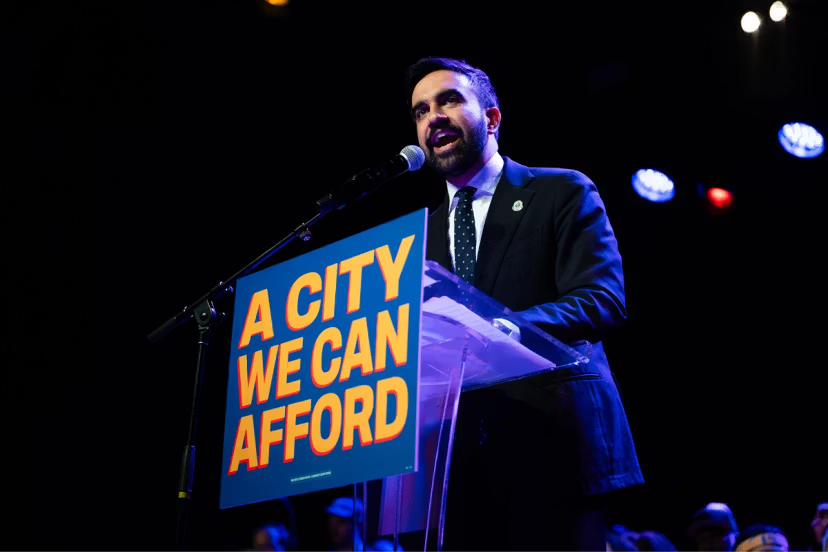
The election of Zohran Mamdani as Mayor of New York City has been a real political turnaround for the city. The 34-year-old Democratic Socialist, and state assemblyman, Mamdani became the winner of the Democratic primary and then the general election. The election brought about the highest turnout of voters since 1969. He went from a quite unknown person to a celebrated figure. His victory, which was powered by a platform that New York was not affordable anymore for its people, was also a breakthrough for the progressive politics focusing on economic inequality in the city. His ideas, among which are universal childcare, free buses for everyone, and a rent freeze, have caused such an uproar that the discussions are all about what is possible and what is necessary for New York’s future, with different opinions about it.
Hand in hand with the election of Mamdani, a new type of city management has been opened up. In the past, such a thinking would be unthinkable. New York has always been an icon of tough economic conditions, and its government has taken a soft approach towards the social issues that came with it, i.e. poverty, homelessness etc. But the era of such indirect confrontation with urban problems seems to be over. The new mayor’s proposal includes:
Key Policy Promises and Proposals:
Central to Mamdani’s campaign was the direct confrontation of the costly living situation in the city through a series of policies. The proposals serve to exploit the might of the municipal government to put up a better-off social safety net, that will be heavily tax-based on the wealthiest of individuals and corporations.
Universal Childcare:
Possibly the most important point of his platform, Mamdani has suggested that free and universal childcare should be offered for every child in New York City from six weeks to five years old. New Yorkers pay almost 26,000 a year for childcare on average. The purpose of the policy is to remove a great financial burden from families. Furthermore, the plan is also going to give a considerable increase in the salaries for caretakers, making them equal to the ones in public schools, thus, also addressing poor pay in the industry. This program would mainly depend on the taxing of high earners and large corporations.
Free Bus Service and Public Transit:
Mamdani has vowed to make all the city buses free of charge, thus extending a trial run in the pandemic times. He advocates for the free buses, along with the setting up of more bus lanes and their quick service, to be the main ingredients of the transportation system that has been made more just and efficient. Just like his child care proposal, this one will also be financed with the help of corporate tax hikes and income tax on citizens earning more than a million dollars a year.
Housing Affordability and Rent Freezes:
Mamdani is tackling the rental crisis in the city with the plan to freeze rents on one million units that are covered by rent stabilization. He claims to do thorough the Rent Guidelines Board and have members prevent any increases in rent. Besides this, he will have the city build three times more affordable homes than it does now.
City-Run Grocery Stores:
One of the most controversial propositions of his is the idea of five government-subsidized grocery stores, one in each borough. The new mayor calls it a, “public option for produce,” and he claims that it will be a way out of the problem of increasing food prices. Critics are saying that the plan is reminiscent of Soviet-style rationing, while supporters are referring to the examples of Istanbul and Chicago where similar models have worked.
Funding Mechanism
Taxing the Wealthy:
A considerable rise in taxes on the rich and corporations is the main source of financing these ambitious proposals. Mamdani has suggested a uniform 2% income tax hike for New Yorkers whose annual income exceeds one million dollars and an increase in the corporate tax rate from 9% to 11.5%. He estimates that the city could make $5 billion extra every year through this.
Allegations and Controversies
Mamdani’s rapid ascent to power has been a matter of keen interest and discussion, and the skeptics have not only focused on his integrity but also pointed out that some of his statements might provoke division.
The Rent-Stabilized Apartment Controversy:
One of the major hooks with which to criticize Mamdani has been his decision to occupy a rent-stabilized apartment in Astoria at the price of $2,300 per month, while holding a $142,000 salary as an assemblyman and being part of a wealthy family. His opponents argue that it is a clear case of misallocation of a housing resource aimed at low to middle-income New Yorkers. Mamdani has been subjected to extensive criticism, which even led former Governor Andrew Cuomo to propose a measure known as, “Zohran’s Law,” that would set income restrictions on such units, and he has promised to vacate the apartment.
Symbolic Missteps and Community Relations:
The use of incendiary terms and gestures by Mamdani has brought about adverse reactions. His “globalize the intifada” allusion, among others, has received disapproval and branded some as unhelpful or even antisemitic. Moreover, the outbursts of the Italian-American heritage groups were a consequence of a tweet where Mamdani was pictured giving a middle finger to Christopher Columbus’ statue, thus making the charge of cultural insensitivity against him even stronger.
Geopolitical Stances:
In the realm of geopolitical issues, the remark by Mamdani that he would have the Israeli Prime Minister Benjamin Netanyahu arrested according to the ICC’s warrant, therefore aligning the city with “international law,” created a furor. His claims have only reinforced the perception of him being a politician brave enough to wade into the thickest controversies.
The “Unrealistic” Label: Pragmatism or Fantasy?
As always, the question of the realist or idealist side of Mamdani’s proposals and the discussion surrounding it, whether practically manageable or not, lies at the root of the matter.
The Legal and Political Hurdles:
Controversially the most practical issue is that certain features of Mamdani’s proposal, particularly the tax actions, are not completely under the control of a mayor. There is a need for state legislature approval and the governor’s consent. Kathy Hochul, the governor who endorsed Mamdani, has been clear in her opposition to the raising of the taxes on the wealthy by declaring, “I don’t want to lose any more people to Palm Beach. We’ve lost enough.” This creates the conditions for a possible political stalemate in Albany.
International and Historical Precedents:
A lot of Mamdani’s suggestions are criticized and labeled as “unrealistic” but these ideas are usual policies in many places around the globe. A European opinion stated, “He promised things that Europeans take for granted.” Free or heavily subsidized daycare is a common practice in the Nordic countries and in cities like Berlin. The no-fare public transport has already been installed in Estonia’s capital Tallinn and in Luxembourg. In fact, rent stabilization has been a part of New York’s recent history where it has been done four times during Mayor Bill de Blasio’s period. The grocery store project run by the city has been a political and social success in Istanbul, creating a core voter base among the working-class through their enduring loyalty.
The Campaign Finance Model:
An important element that played a huge role in Mamdani’s triumph was New York City’s public campaign finance system, though it is not usually mentioned. The system, which combines small donations and public funds, helped Mamdani to have a total of nearly $13 million, while at the same time oligarchs had spent dozens of millions on his opponents like Andrew Cuomo. This enabled him to perform a competitive, policy-driven campaign without turning to big corporate sponsors, thus demonstrating that a candidate with a similar stance could not only but also gain the support needed to win.
Is Zohran Mamdani the Right Fit for Modern NYC?
The issue of whether Zohran Mamdani is the right candidate for New York City is really about the city’s identity and future direction. His victory is a clear indicator of a system pushed to its limit where record bonuses on Wall Street are hotly debated amidst the ongoing affordable housing crisis for the common man.
For those who back him, Mamdani is just the fearless and courageous leader modern New York needs. He makes a point of difference from what they regard as past austerity politics, which have completely failed. He has given a clear and practical solution to the daily problems of New Yorkers who are suffering with the high cost of childcare, unreliable public transport, and the fear of not being able to afford their own homes. The international examples of his policies indicate that they are not radical fantasies but proven tools of social welfare that could turn New York into a more humane and livable city.
On the other hand, the critics of Mamdani, who include influential business, fear that his measures will slow down the economy and hence will lead to a retraction of public and private investments, besides causing a budget crisis as a result of a huge public debt. His political challenges are huge, and they make the prospect of a city government that is stagnant and gridlocked even more likely.
Mamdani’s New York City mayorship will serve as a real-life experiment for a new urban populism in America, to be continued or halted depending on Zohran Mamdani’s capacity to play the political game wisely and to build coalitions that will ultimately lead to the realization of the promised benefits for the residents of New York through tangible improvements. He has already successfully changed the political conversation in New York, and now, it will be the city and the world that will see if he can also change its reality.