
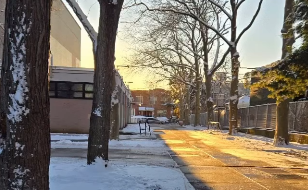
Despite serving over 3,000 students, Franklin Delano Roosevelt High School funnels everyone through just two metal detectors and a single entrance on scanning days. Entry procedures at Franklin Delano Roosevelt have long relied on a straightforward system in which students walk into the building and proceed through security every morning from campus. In addition, at the school introduced a buzzer-entry system this year to regulate access more closely through the main entrance on 20th Ave, requiring late students and guests to signal before entering. When combined with the two metal detectors each morning, we see the process from a logistical standpoint.
One of the school security agents responsible for metal detectors, said that the volume of students is one of the main factors shaping how quickly the lines move. “About 3,000 students a day come in these lines,” he said. “Not many students get late because of this extra step, they come in fine.” He also noted that the equipment itself plays a major role in how smoothly mornings run. He described the detectors as, “up to date” and “extremely accurate,” emphasizing that accuracy is essential for maintaining safety. At the same time, he acknowledged that technical problems can occasionally disrupt the process. When asked how often issues occur, “From what I last remember, it was about seven times it has stopped working and led to an unfortunate delay for students to get in,” he said.
Many students report that the process significantly affects their morning schedule. Lin Y., a junior, said he often feels frustrated by the delays. “I am sick about that, and I have to wait for a long time every day in the morning,” he said. “We could add more detectors or move them to somewhere else because the wind will make them not work properly, then we can have 4 doors open.” However, some staff members view the detectors as an efficient part of the school’s security system. “It’s definitely efficient. What students need to do is just put their stuff inside their bag and pass,” One math teacher said. “Even though teachers don’t pass through detectors, I feel they are the most convenient way for school safety.” Ms. Kolesnik noted that the number of detectors may not fully meet the school’s morning demand. “The advantages are definitely school safety, and what can be improved is not enough detectors because I could see there are a lot of students waiting outside when sometimes I walk by the hallway,” she added.
The reality is that the school does not get to decide the number of metal detectors. According to one of the Deans, the Department of Education and Borough Safety units decide the system we have set up, and there needs to be one central area for students to enter. The campus entrance is the only location which has four doors and can accommodate the students lining up to enter. Basically, the size of the space matters as to where the students enter and the setup for scanning. In addition, if students actually put their belongings in their bag before entering the line would move much quicker. Students emptying their pockets at the scanner and placing their belongings on trays greatly slows down the process.
As conversations about school security continue, many students and staff say the challenging routine is manageable and worth the safety benefit. For those who wait in the lines each morning, the hope is simply for a process that feels both safe and efficient. As Lin Y. put it, “Safety is always important.”